Organization membership
- What
- Users work within an organization.
- Why
- Business records need to belong to the right organization.
- How
- Membership records connect users to organizations and their roles.
Multi-tenant business management application with organization-based access and modular workflows.
Small businesses struggle with disconnected departmental workflows, fragmented operational records, and lack of database-enforced multi-tenant data isolation.
Full-Stack Software Engineer (Sole Developer)
Organization membership and PostgreSQL row-level security policies restrict access to tenant records.
Erpixa is a business operations platform built by analyzing small business departmental workflows, multi-tier organizational hierarchies, and cross-team data access requirements. It translates organizational boundaries into PostgreSQL database-level security policies and modular UI workflows.
Modeled multi-tenant organization boundaries, defined member RBAC, and engineered the React, TypeScript, and PostgreSQL application with engine-level row-level security.
PostgreSQL stores organizations, members and business records. Organization relationships connect records to the business they belong to. Database policies use membership when checking access.
organization_idnamebusiness_typetax_schemecurrencyenabled_modulesroleuser_idThe React application uses authenticated data operations to read and update organization records. The database applies the organization access rules to those operations.
End-to-end system lifecycle
Database access control · Row-level security for multi-tenant isolation. Excerpt from the repository source.
-- PostgreSQL row-level security policy for multi-tenant isolation
CREATE POLICY org_members_isolation ON public.invoices
FOR ALL
USING (
public.is_org_member(organization_id)
)
WITH CHECK (
public.is_org_member(organization_id)
);
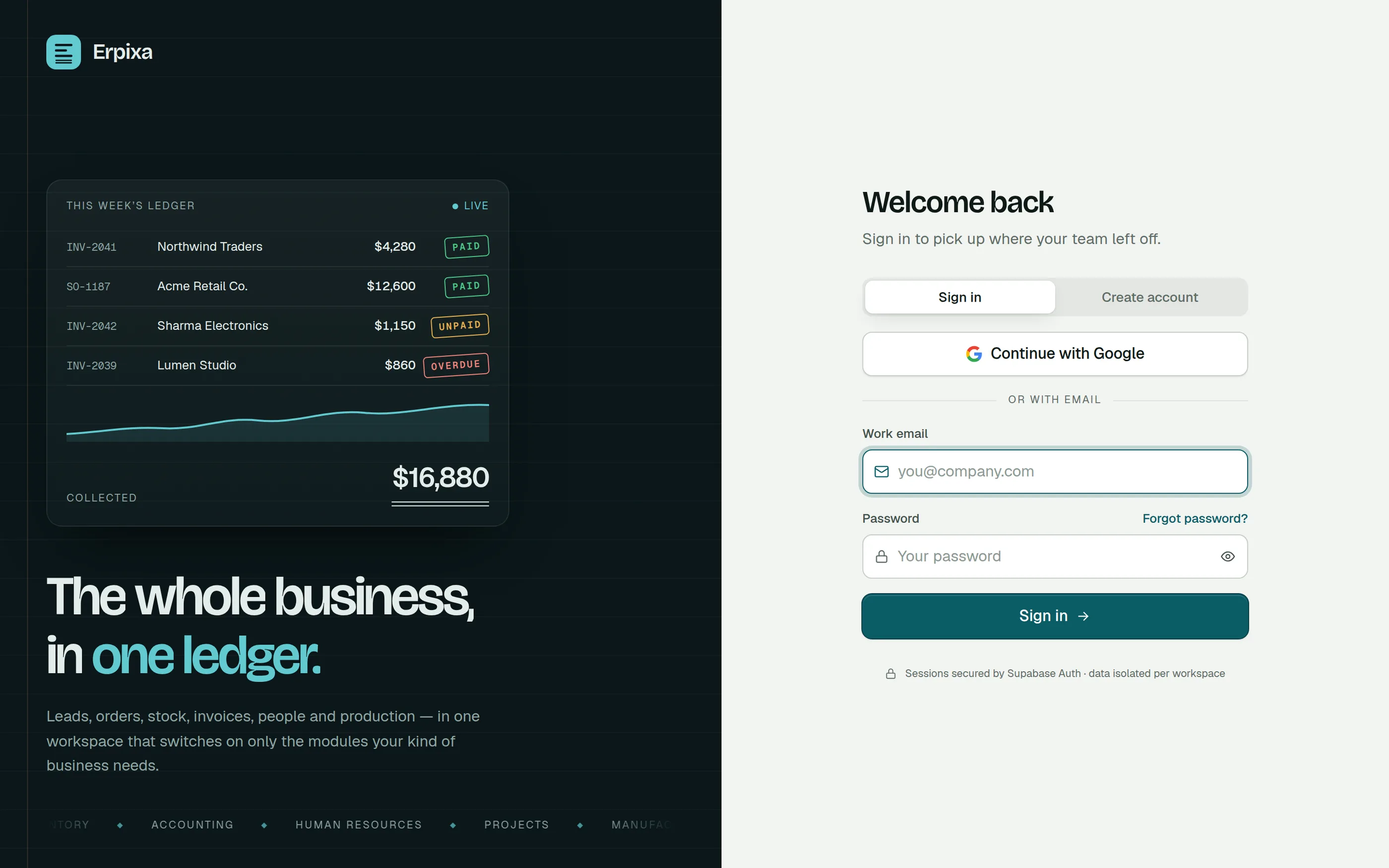
CREATE INDEX idx_org_members_user ON public.organization_members(user_id);The deployed interface brings organization selection and business workflows into one application.
React · TypeScript · PostgreSQL · Database design · Authentication · Role-based access · Organization-level data access